TORSION SPRING FAILURE GUIDE — THOUSAND OAKS
7 Warning Signs Your Garage Door Torsion Spring Is About to Break in Thousand Oaks
A torsion spring does not break without warning — it gives you signals weeks or months before it snaps. Here are the seven signs Thousand Oaks homeowners should know. Catching the spring before it breaks means you choose when the repair happens — not the spring.
Sign 1 — The Door Moves Unevenly or Jerks When Opening
A torsion spring system with two springs balances the weight of the door evenly across both springs. When one spring loses tension because it is nearing the end of its service life, it contributes less force to the opening cycle than the other spring. The door responds by pulling slightly to the side of the weaker spring — the operator strains, the door rises unevenly, or it jerks at specific points in the travel arc. This is different from a track alignment issue, which produces a scraping sound, or a roller problem, which produces a grinding sound. A smooth jerk or one-sided pull with no scraping is almost always a spring tension imbalance.
Sign 2 — You Heard a Loud Bang From the Garage
A torsion spring that breaks releases all its stored torque in a single instant. The bang is loud enough to startle someone in an adjacent room — often described as a gunshot or a car backfire. If you hear a loud bang from your garage, the spring has already broken. You will know immediately because the door will either not respond to the opener, respond but not move, or move only 6 inches before the opener stops. Do not attempt to manually operate the door until you have confirmed the spring is broken and assessed the cable condition. Call (805) 294-1314. This is a fast response situation.
Sign 3 — The Door Feels Heavier Than It Used To
A properly balanced garage door should lift with one hand from the bottom center when the opener is disconnected — the spring counterbalances the door weight so that the door feels nearly weightless. When a torsion spring is losing tension near the end of its service life, the counterbalance is incomplete. The door feels heavy when lifted manually — noticeably heavier than it did one or two years ago. If you disconnect the opener and the door requires significant effort to lift past the first foot of travel, the spring is losing tension. Test this in the fall before Santa Ana wind season — a heavy door is a spring replacement job before the next wind event.
Sign 4 — There Is a Visible Gap in the Spring
Look at your torsion spring — the horizontal cylinder mounted above the garage door on a metal shaft. A healthy spring looks like a tightly wound coil with no separation between the individual coils. A spring that has already partially failed shows a visible gap in the coil — a section where the coils have separated and the spring has effectively broken at that point. This gap may be 1/4 inch to 3 inches wide. The spring may still be functioning — barely — but the gap means failure is imminent. You may get one or two more days of operation before it fails completely. Call (805) 294-1314 today.
Sign 5 — The Cables Are Loose or Hanging to the Side
The cables on a garage door run from the bottom corners of the door up to cable drums mounted at each end of the torsion spring shaft. When the spring breaks, the cable drums stop turning and the cables go slack. Slack cables hang loosely along the vertical track and sometimes fall off the drum completely and hang in a loop near the floor. If you see loose cables on either side of your garage door — not wrapped taut around their drums and not running straight up to the corner brackets — the spring has already broken or the cable anchor has failed. Do not operate the door. Call (805) 294-1314.
Sign 6 — The Door Opens Only 6 Inches Then Stops
LiftMaster, Chamberlain, and Genie openers include an auto-stop safety feature that detects excessive motor load and stops the door. When a torsion spring breaks, the opener tries to lift the full unbalanced weight of the door — typically 150 to 250 pounds — without the spring counterbalance. The motor encounters this load, the auto-stop triggers, and the door rises 4 to 6 inches and stops. The opener light blinks and the motor does not continue. If your door opens 4 to 6 inches and stops reliably on every attempt, the spring is broken. The opener auto-stop is working exactly as designed — it is protecting the motor from burning out under the unbalanced load. Call (805) 294-1314.
Sign 7 — The Spring Shows Rust, Corrosion, or Wear
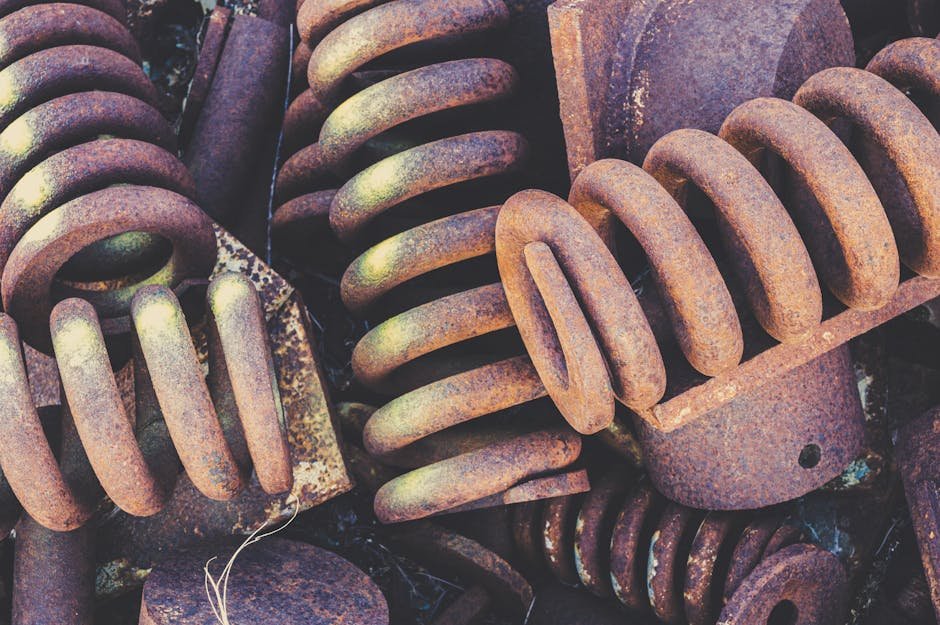
Look at the surface of your torsion spring — specifically the outer coils. A spring in good condition has a uniform silver or charcoal grey finish. A spring approaching end-of-life in a Thousand Oaks garage shows surface rust (orange-brown discoloration), particularly in homes near the Conejo Valley hillsides where marine layer humidity and ash from past fire events accelerate corrosion. A spring with visible rust has accelerated fatigue in the corroded sections — the cross-section of the spring wire is thinner where rust has attacked it and will fail under less load than a clean spring. A visibly corroded spring needs replacement even if it is still functioning.
FAQ — Torsion Spring Failure in Thousand Oaks
Seeing any of these 7 warning signs in Thousand Oaks?
Call (805) 294-1314 — Before the Spring Breaks
Don’t wait for the loud bang. Fast spring replacement from Thousand Oaks. Both springs replaced in one visit. Written estimate before any work starts.